
Revenue & profitability
Short-term rental investment on the French Riviera: owner's guide
Invest in an Airbnb property on the French Riviera: expected return, cities by profile, property types that perform, full costs and steps before purchase.
9 min · Mis à jour le 20 mai 2026
Short-term rental investment on the French Riviera: what to know before buying
The French Riviera attracts rental investors for easy-to-grasp reasons: steady tourism demand year-round, high price per square meter but proportional short-term rents, favorable LMNP tax treatment, and property appreciation over time. Yet behind this appeal, real return depends on precise choices: city, neighborhood, property type, management mode and tax strategy.
This article summarizes the key parameters to arbitrate before buying in Nice, Cannes, Antibes or nearby towns for managed short-term rental.
Direct answer: what return to target?
For a well-calibrated short-term investment on the French Riviera, annual gross return lands between 5% and 8% of purchase price net of fees. Net return after commission, costs, fees and taxes generally settles between 3.5% and 5.5%.
These ranges exceed traditional long-term rental (often 2.5% to 4% gross on the same area) but assume solid operational execution. The same property poorly managed can drop to 2% or 3% real net return.
Cities by investor profile
Each French Riviera city has specific rental and property profiles.
- Nice: most liquid market, steady demand year-round, more accessible entry prices than Cannes or Saint-Jean. Ideal for first-time investors or steady income.
- Cannes: seasonal market with event peaks (Festival, MIPIM, Cannes Lions). Higher return potential but greater variance. Suits investors accepting seasonality.
- Antibes: family summer tourism, Old Town charm, Sophia Antipolis proximity. More temperate market than Nice or Cannes.
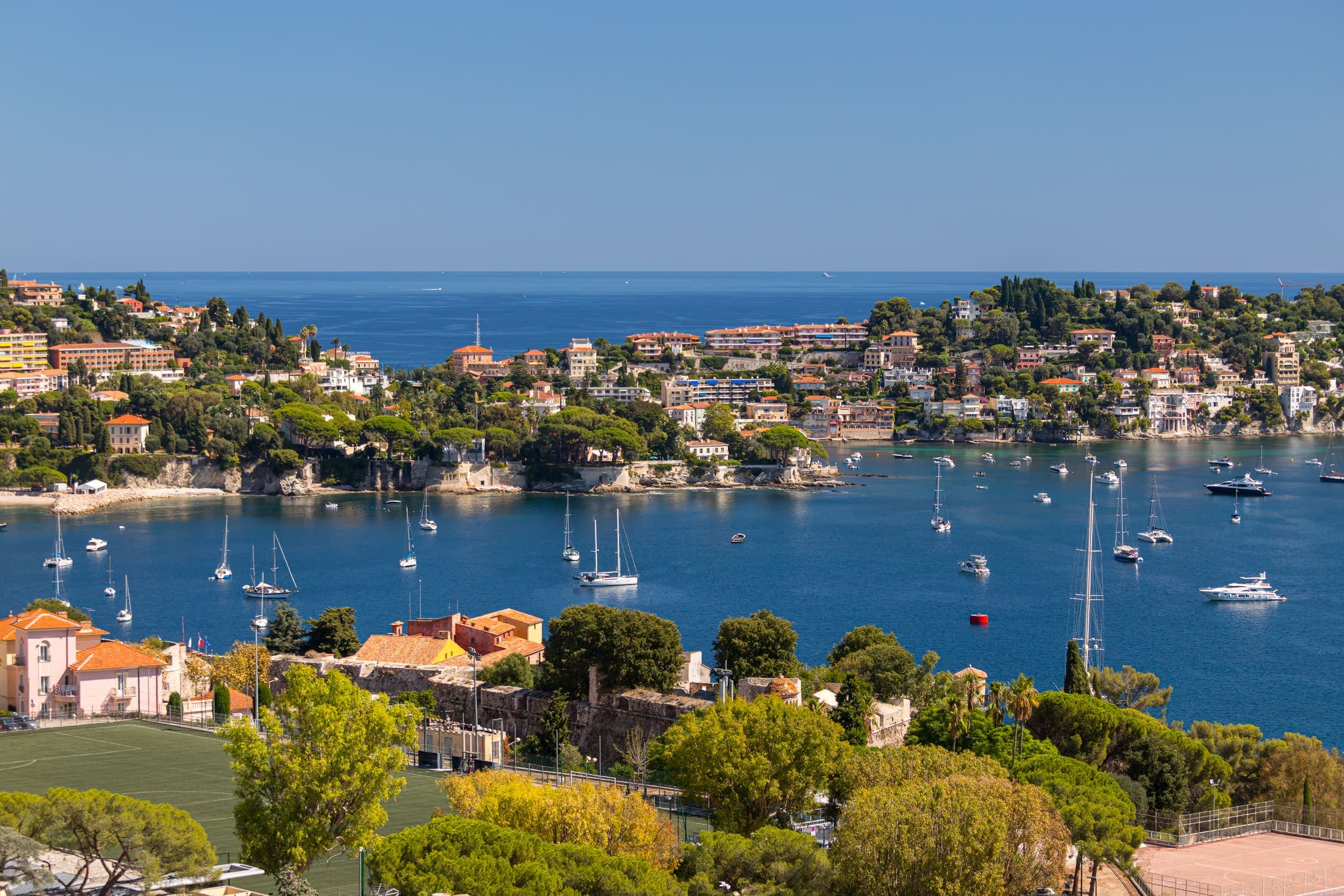
- Villefranche-sur-Mer: niche market, high-value individual properties, international guests. High entry cost but solid returns on exceptional properties.
- Cagnes-sur-Mer, Saint-Laurent-du-Var: more accessible per-square-meter prices, mixed clientele (leisure, airport, business). Good compromise for first investment on tight budget.
Property types that perform best
On the French Riviera, certain types outperform others in short-term:
- Studio to 2-room center-city: strong demand, quick turnover, moderate entry cost (250,000 to 450,000 euros in Nice proper). Typical first-investment profile.
- 3-4 rooms with outdoor: summer families, long stays, high peak-season prices. Requires fine seasonal calibration.
- Sea-view apartment: high entry cost but sustainable year-round pricing, strong guest loyalty.
- Villa with pool: very high entry cost (1M euros+), marked seasonality, strong high-season margins but complex management.
Properties to avoid for short-term: difficult-access duplexes, high-floor units without lift, co-owner rules prohibiting or limiting short-term rental.
Full costs to anticipate
Too many investors reason on gross return without integrating true costs. For realistic net return, factor in:
- Acquisition: notary fees (7-8% on used property), agent fees (3-5%), bank fees if financed, first works and equipment (often 8,000 to 25,000 euros for premium-level launch).
- Daily management: concierge commission from 20% TTC per scope, per-turnover cleaning (60-130 euros), professional linen rental, supplies, platform fees.
- Fixed costs: property tax, co-owner fees, utilities (short-term uses more), appropriate home insurance, internet, subscriptions.
- Maintenance: reserve 5-10% of annual gross for wear and replacement.
- Tax: per LMNP micro-BIC or real regime, between 0% and 30% of profit based on situation.
Real net income typically represents 40-60% of displayed gross revenue.
The golden rule: location before all else
On the French Riviera, classic real estate holds true for short-term: location matters more than anything else. A modest studio on Croisette or in Carré d'Or Nice outperforms a large new apartment on the periphery.
Four location criteria carry heavy weight:
- Walking distance to center or beaches (ideally under 10 minutes).
- Transport access (tram in Nice, SNCF stations, airport).
- Noise level (avoid ground-floor on heavy-traffic streets).
- Co-owner quality (maintenance, concierge, short-term tolerance).
Poor location does not fix itself with nice furniture or good concierge.
Buying to rent: key steps
To structure a short-term purchase:
- Define full budget: purchase price + fees + works + equipment + startup cash.
- Target 2-3 cities per your profile (steady or seasonal income, first or diversified investment).
- Visit with rental eyes: not "would I like to live here?" but "would a guest pay to stay here?".
- Run detailed projections before offer: estimated gross revenue, costs, taxes, realistic net return.
- Verify co-owner rules before signing: short-term rental prohibition clauses are increasingly common.
- Prepare for handoff: equipment, professional photos, listing, town hall filing, tax regime choice.
Our role in your investment
Hostias is neither a realtor nor investment advisor. We do not recommend specific properties or cities.
We can help on three phases of your journey:
- Pre-purchase: revenue projection on a property you are considering, reading rental potential, spotting operational obstacles (access, co-owner, equipment).
- Handoff: full management takeover at delivery, photos, listing, multi-channel distribution, operational launch.
- Long-term: monthly reporting, continuous optimization, improvement recommendations.
For a projection on a property you are studying, request a free audit. We return with a reasoned range and our operational remarks before you sign.
Want a read on your property?
Get a free estimate